Chrysostom's funeral and Marcela's defense
Don QuixoteChrysostom's funeral and Marcela's defense brings a private tragedy before a gathering of mourners, then unsettles their assumptions about who is responsible for it. At the graveside, Ambrosio presents Chrysostom as a gifted friend destroyed by unreturned love; Marcela arrives to challenge that account, insisting that beauty and another person's desire create no obligation to love in return. The burial becomes not only a farewell to Chrysostom, but a contest over how his story should be told and whether Marcela can be held answerable for his suffering.
The funeral and Ambrosio's account
Don Quixote and his companions encounter the burial party as shepherds bring Chrysostom's body to the place he had chosen for his grave. The dead man lies on a bier covered with flowers and branches, with books and papers laid around him. The scene makes his writing part of the funeral itself: his friends are confronted both with his death and with the record he has left behind.
Ambrosio identifies the grave as the place where Chrysostom first saw Marcela, declared his passion, and was eventually rejected. He remembers his friend as courteous, generous, intelligent, and admirable, but describes his love as a pursuit that ended in despair. The account gives grief a clear antagonist: Ambrosio says Marcela scorned Chrysostom and calls her cruelty the conclusion of his unhappy life. His praise of the dead man and anger at Marcela make the burial a public judgment as well as an act of mourning.
The papers intensify that conflict. Chrysostom had instructed Ambrosio to burn them after his body was buried, and Ambrosio intends to carry out the order. Vivaldo objects that obedience would consign the writings to oblivion and argues that they should remain as a warning to others. He has already taken some pages when Ambrosio agrees to let him keep what he has picked up, while maintaining that the rest will be burned. The scene therefore leaves the dead man's words divided between preservation and deliberate destruction: his friends dispute whether his account of suffering should survive, and what lesson it should teach.
Marcela's defense
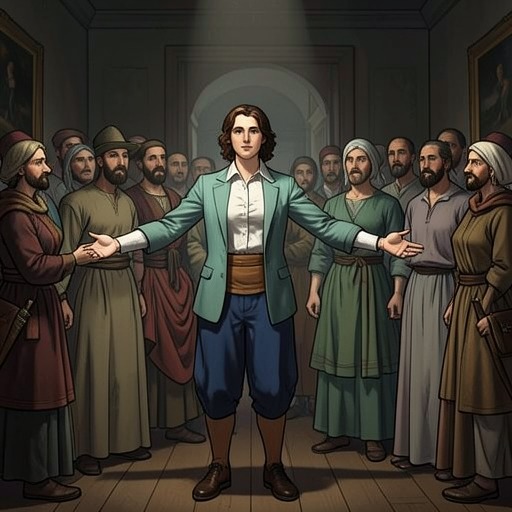
As Vivaldo prepares to read another paper, Marcela appears above the grave. Ambrosio immediately accuses her of coming to look upon the consequences of her cruelty. She answers that she has come to defend herself against those who blame her for Chrysostom's death. Her intervention shifts the gathering from judging her in her absence to hearing her explain the conditions of her own life and choices.
Marcela argues that beauty may attract love but cannot oblige its object to return it. Even mutual beauty would not ensure that two people share the same inclination: affection, in her view, must be voluntary rather than compelled. She also rejects the premise that her appearance is a debt she owes others. Heaven gave her beauty without her choosing it, she says, and its existence does not make her responsible for the desires it awakens. She distinguishes outward attraction from the honour and virtue she considers necessary to true beauty, and refuses to surrender her modesty simply to satisfy a suitor.
Her account of Chrysostom is specific. At the very place where his grave is being prepared, she had already told him that she intended to live in solitude. She says she neither encouraged him nor promised that his love would be returned. His persistence after that declaration, she argues, makes his despair his own rather than proof of her deceit or cruelty. She distinguishes a disappointed lover who was led to hope from one who received no such promise, and rejects the idea that she can be called a deceiver or a killer for maintaining the boundary she had made clear.
Marcela describes solitude as a deliberate choice, not a punishment imposed by rejected love. She has wealth of her own, wants neither another person's property nor another person's company on terms of constraint, and says that she neither loves nor hates any of her suitors. Her life among the mountains, with the shepherd girls and her goats, reflects her preference for freedom. By explaining that choice at the graveside, she contests the mourners' attempt to make Chrysostom's sorrow the measure of her conduct.
Don Quixote's intervention
Marcela leaves without waiting for a reply. Some of the men, still drawn to her, appear ready to follow despite what she has said. Don Quixote intervenes, threatening his anger against anyone who pursues her. He declares that her reasoning has shown her to be at little or no fault in Chrysostom's death and that she should be respected rather than persecuted.
His defense matters because it turns her argument into an immediate test of conduct. Marcela has said that love cannot be forced and that she has not invited pursuit; Don Quixote now uses his own authority to keep the gathered men from overriding her stated wishes. His response arises from his knightly commitment to defend women in distress, yet here that commitment supports Marcela's refusal rather than a conventional claim that a woman should yield to a lover's devotion.
Burial and significance
The shepherds remain in place, whether deterred by Don Quixote or guided by Ambrosio's reminder of their duty to their friend. They finish the grave and bury Chrysostom amid the tears of those present. Ambrosio plans a slab bearing an epitaph that presents the dead man as a victim of a beautiful, ungrateful woman, while Marcela's speech has offered the opposite interpretation: she made no promise, chose solitude, and cannot fairly be blamed for another person's insistence on pursuing her.
The event thus preserves two competing accounts rather than resolving them through a single verdict. The funeral's gestures honor Chrysostom, while the dispute over his papers and Marcela's defense expose the danger of allowing grief to define another person's obligations. Her appearance does not undo the mourning, but it prevents the mourners' accusation from standing uncontested. The closing burial returns attention to Chrysostom's death; Don Quixote's protection ensures that Marcela is not made to pay for it with further pursuit.